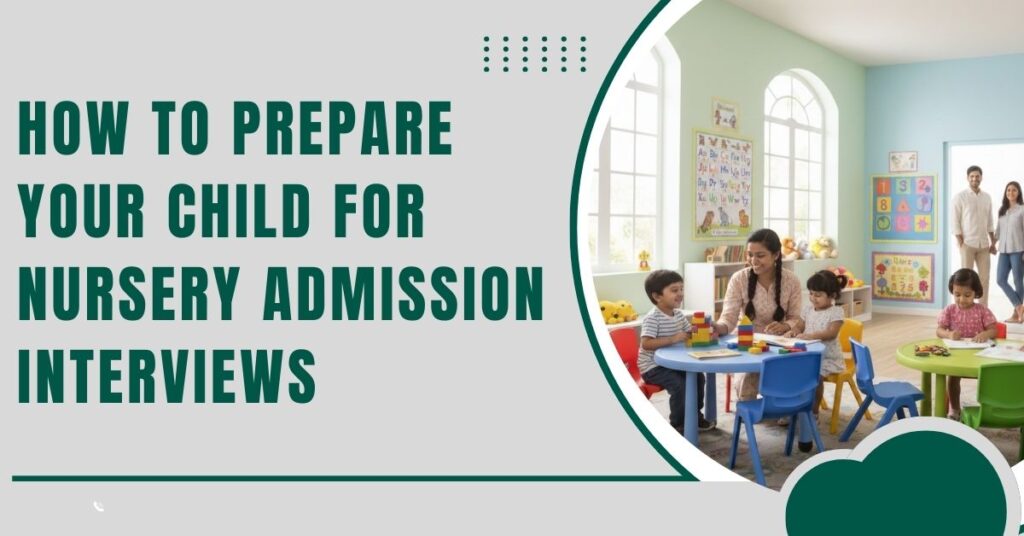
Your child’s first school interview is more than just an admission step — it’s the beginning of a beautiful educational journey. For many parents, nursery admission interviews can feel overwhelming. Questions like “What will they ask?”, “Is my child prepared?”, or “What if my child feels shy?” are completely natural. The good news is that nursery interviews are not about testing intelligence — they are about understanding your child’s personality, comfort level, basic communication skills, and readiness for a joyful learning environment.
With the right preparation and a calm approach, this experience can become exciting rather than stressful — for both you and your little one. A nurturing school looks for curiosity, confidence, and a supportive home environment far more than memorised answers. In this guide, we’ll walk you through practical strategies, sample questions, parent tips, and confidence-building techniques to ensure your child walks into their nursery interview smiling — and walks out feeling proud.
Why nursery interviews happen (what schools are actually assessing)
Nursery “interviews” are usually brief, warm-and-play style conversations designed to understand a child’s developmental milestones and temperament — not to “test” them. Schools look for simple communication skills, basic recognition (name, colours, shapes), ability to follow one- or two-step instructions, social comfort with a new adult/peer, and general self-help skills (like feeding or basic toileting where appropriate). Schools also want to learn about the family’s values and expectations in a short parent chat.
How to prepare — the mindset (parents first)
- Keep it calm and child-centered. The goal is to build familiarity with the format — not to over-drill. Role-play in short, playful bursts.
- Start a few weeks earlier. Small, consistent practice sessions (5–10 minutes) are better than marathon rehearsals.
- Focus on confidence, not perfection. Schools prefer authentic answers and a relaxed child. Don’t encourage rote memorisation.
What children are commonly asked (age-appropriate examples)
These are very common across preschools and nursery interviews — practise in playful ways.
Personal & conversational
- What is your name? / How old are you?
- Who is in your family? (mama/dada, siblings)
- What’s your favourite toy/colour/food?
Recognition & basic knowledge
- Can you name this colour/shape/animal?
- Can you point to the circle/triangle/red/blue?
Routines & social
- Do you like stories/songs/playtime? Who is your friend?
- Can you follow a simple instruction: “Please put the ball in the box”?
Skills schools may notice (informally)
- Ability to sit briefly, listen to a short story, turn pages, attempt a puzzle or stack blocks.
What parents are typically asked
- Why did you choose this school?
- How is your child with routine, sleep and food?
- Are both parents working? (schools ask to understand logistics)
- How do you support learning at home? (reading, play, outings)
Tip: Keep parent answers concise and truthful. Emphasise values (safety, curiosity, kindness) and practical supports (reading time, playdates, consistency in routine).
A practical 2-week prep plan
Day-by-day is unnecessary — aim for gentle routines:
Week 1 — Familiarity & fun
- Read a short story daily. Ask 1–2 simple questions about the story.
- Play “name games” (sing their name, ask “what’s your name?”) for 5 min.
- Colour sorting & shape blocks (playful, 10–15 mins).
Week 2 — Role-play & routines
- Do two short role-play interviews (parent = teacher) — keep it playful.
- Practice a simple two-step instruction game (“give me the ball, then sit”).
- Short independence tasks: feeding with a spoon, putting on shoes.
Always end practice with praise and a treat (sticker, hug) — keep it positive.
Do’s and Don’ts
Do
- Keep practice short, positive, and playful.
- Model calm behaviour before the interview.
- Bring a familiar comfort item (if the school allows).
- Arrive 10–15 minutes early to settle in.
Don’t
- Over-rehearse scripted answers.
- Make the interview a threat or punishment.
- Correct every small mistake in front of the child.
- Compare your child to another in front of them.
Sample interview scripts — child and parent
Child — simple, natural responses (examples you can practise):
Interviewer: “What is your name?” — Child: “My name is Aarav.”
Interviewer: “Which colour do you like?” — Child: “Blue.”
Interviewer: “Can you show me how you clap?” — Child: (claps)
Parent — short, confident answers:
Interviewer: “Why our school?” — Parent: “We value a balanced learning environment and warm teachers. We believe this school’s approach matches our goal of academic plus character growth.”
Interviewer: “How is your child with routines?” — Parent: “She has a regular sleep and meal routine and enjoys storytime every day; she’s comfortable with short group play.”
What to bring on the day (checklist)
- Original + copy of required documents (birth certificate, ID, application form)
- Recent photo of child (as requested)
- A familiar toy/comfort item (optional, and only if allowed)
- Water bottle & a small snack (confirm school policy)
- Calm parent attitude and realistic expectations
Handling a shy or anxious child
- Let the child lead: allow them to play first and warm up.
- Introduce yourself quietly to the teacher; step back when child interacts.
- If they cry, don’t force separation — many schools expect tears and can accommodate.
- Speak to staff afterward about transition plans (gradual entry, parent stay if allowed).
How to Choose the Best Nursery School for Your Child
Selecting the right nursery school is one of the most important decisions you’ll make for your child’s early years. Beyond academics, the right environment should nurture curiosity, confidence, emotional security, and social skills. Here’s what you should carefully evaluate before finalising a school:
Teaching Approach & Curriculum
Look for a balanced curriculum that focuses on experiential learning, play-based activities, language development, and foundational numeracy. Ask how the school blends academics with creativity, storytelling, music, and movement.
Teacher Qualifications & Student Attention
Early childhood education requires trained, patient, and compassionate teachers. Check the teacher-student ratio — smaller class sizes ensure better individual attention and stronger emotional bonding.
Safety & Infrastructure
Ensure the campus is safe, hygienic, and child-friendly. Look for CCTV surveillance, secure entry/exit points, clean classrooms, safe play areas, and well-maintained facilities.
Holistic Development Opportunities
A strong nursery program should go beyond classroom learning. Explore whether the school offers activities such as art, dance, storytelling, celebrations, hands-on projects, and interactive learning experiences that help develop creativity and social confidence.
Communication & Parent Partnership
Open communication between parents and teachers is crucial. Ask about regular updates, parent-teacher meetings, progress reports, and involvement opportunities.
Academic Continuity
Consider whether the school offers a seamless journey beyond nursery. A campus that provides continued schooling through higher grades ensures stability and long-term academic planning.
Choosing the right nursery school means selecting a place where your child feels safe, confident, and excited to learn every day. Rosary Schools & Jr. College, offering seamless education from pre-primary to junior college under SSC and ICSE boards, nurtures academic excellence, strong values, and holistic development through modern facilities and personalised attention — laying the foundation for lifelong success.
Give Your Child the Perfect Start
The early years of education lay the foundation for your child’s confidence, curiosity, and lifelong love for learning. Choosing the right school is not just about clearing an admission interview — it’s about finding a nurturing environment where your child feels secure, supported, and inspired to grow every single day. When academic excellence blends with character building and holistic development, children don’t just learn — they thrive.
If you are looking for a trusted nursery school in Camp Pune, Rosary Schools & Jr. College offers a strong and seamless educational journey from pre-primary to junior college under SSC and ICSE boards. With modern infrastructure, individual attention, and a focus on all-round growth, the school ensures your child’s first step into education becomes the beginning of a bright and successful future.